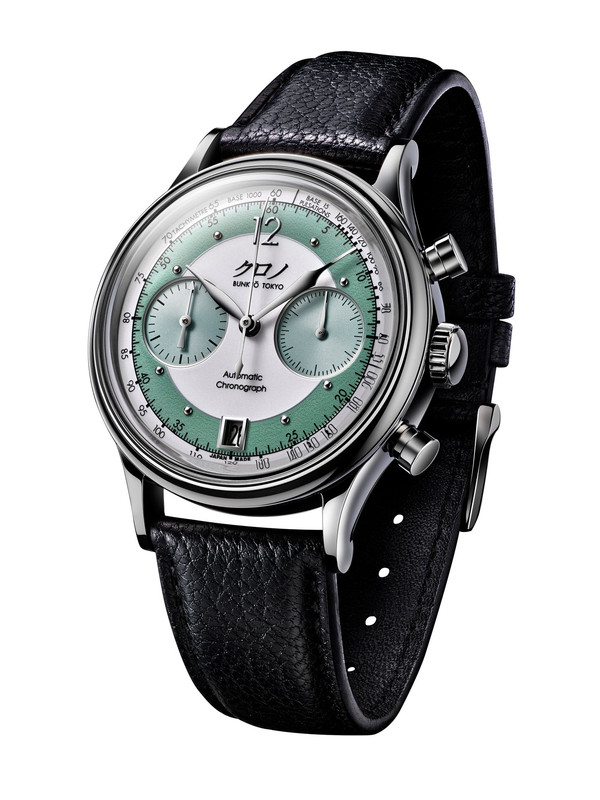
CHRONOGRAPH 3 HISUI:翡翠
Chronograph 3 HISUI:翡翠 is highlighted by a jade-green band around the primary indices. Pointillism technique was applied for the jade-green radial to deliver an expression of the stone texture of jadeite. It is then imbued with micro-metallic particles to mimic the mineral inclusions in raw jade. A final coat of clear glossy lacquer is then applied to seal, resulting in a very pleasant sheen and vibrancy. HISUI:翡翠 introduces a multi-layered dye process that juxtaposes colored textured finishes against a white polished lacquer base, a first in any Kurono timepiece.
The subdials at '3' and '9' are guilloche-engraved radially and finished in light turquoise. Together with the slightly off-white lacquer dial, these three textures and colors come together beautifully to portray the Itoigawa jade.
Chronograph 3 leverages the thinner Mk.2 case construction making it wear significantly slimmer than its predecessors. Extreme light-play is accentuated, taking on rich green to light seafoam tones according to the angle of light magnified through the box-sapphire glass.
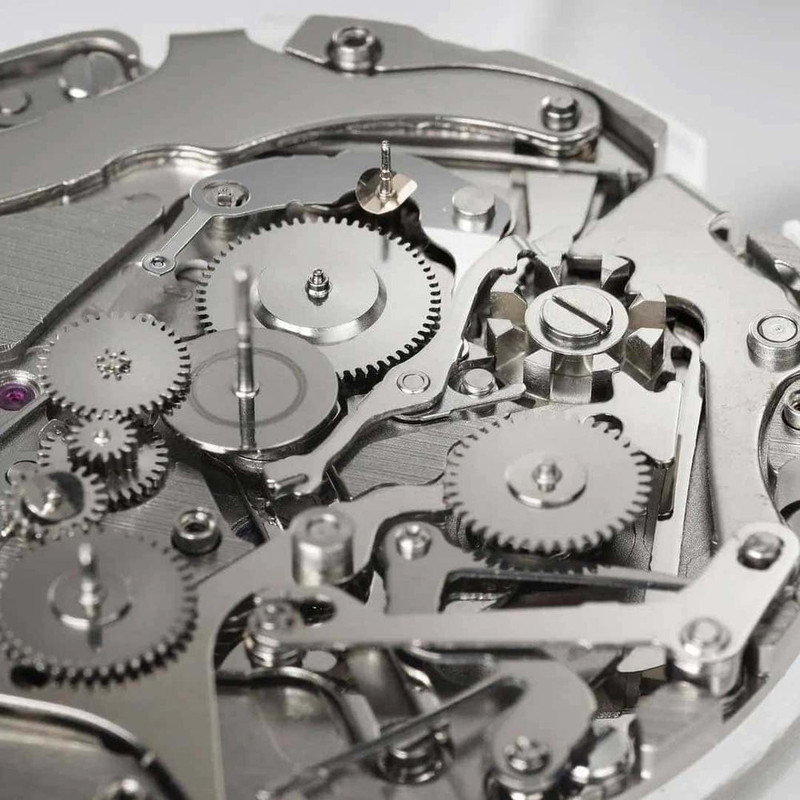
Movement
Hajime Asaoka chose the mechanical chronograph caliber NE86 from one of Japan's most esteemed movement manufacturers. Positioned by SII as its newest flagship chronograph movement and successor to the 6S - it is a premium caliber. The 311-part movement combines traditional chronograph features like a column wheel, vertical clutch, and a magic lever winding system. It has a unique three-pointed hammer system that starts, stops, and resets all three wheels simultaneously.
This allows for all the counters to advance continuously rather than only at one-minute intervals. Additionally, instead of driving the minute and hour counters from the chronograph seconds wheel, each is driven by a powered wheel with its own clutch. This delivers increased accuracy and longer-term durability. The movement also has a power reserve of 45 hours. The NE86 is a movement that even Mr. Asaoka, who makes his own movements, trusts.
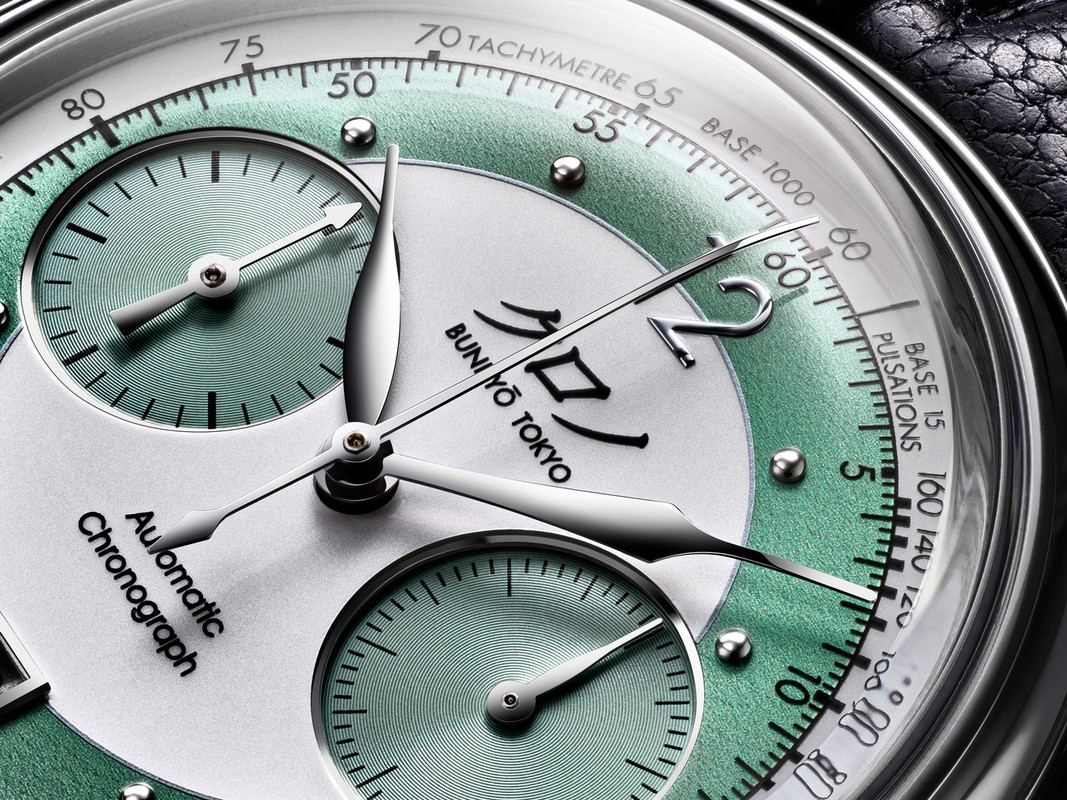
Hands
The combination of high-polish leaf hands and modern hour and minute hands is iconic to Kurono. The tips of the minute and chronograph seconds hands are bent by hand to match the curves of the dial and glass. The guilloche subdial at '9' is set with a unique subhand in the shape of a traditional Japanese 'kyudo' arrow.
The different shapes of all hands is a device used in the high-end chronographs of the 1950s and 1960s, which Mr. Asaoka is fond of. (Anecdotally, the hands were initially bent by hand over the roof of a die-cast toy car to get a consistently perfect angle. Kurono hands are still bent by hand today


